


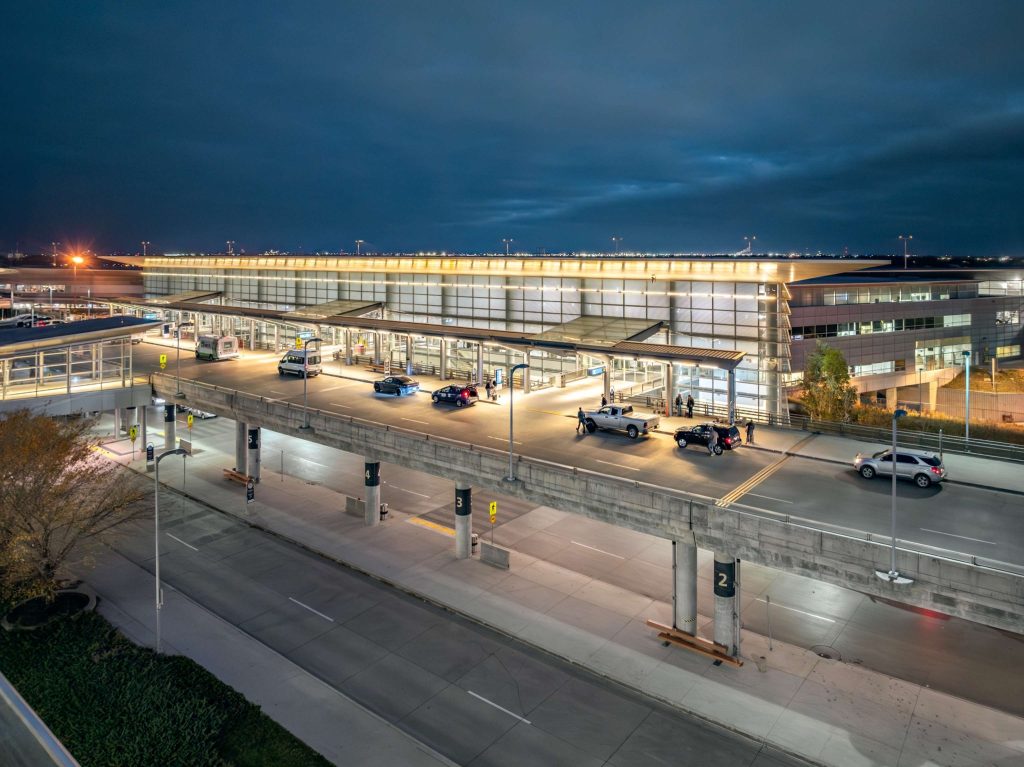
 Few Canadian cities enjoy the advantage Winnipeg has when it comes to the location of its airport. Unlike airports relegated to distant suburbs in other major cities, Winnipeg’s sits on the edge of the urban core. Minutes from downtown and adjacent to a major inland port, it’s an increasingly important economic advantage for a city competing on logistics and convenience.
“Being one of the few major airports within city limits and close to downtown offers unparalleled convenience for travellers and businesses,” says Kerilee Falloon, director of communications and marketing for the Winnipeg Airport Authority (WAA), the corporation responsible for operating the
Winnipeg Richardson International Airport.
“This proximity reduces travel time, supports tourism and makes Winnipeg an attractive destination for conferences and investment.”

Barry Prentice, a supply chain expert and the director of the University of Manitoba’s Transport Institute jokes that Winnipeg’s slow but steady growth is the historic reason YWG was never pushed outward by rapid residential expansion.
“You can go from downtown to the airport in 20 minutes, if not less,” says Prentice, who also served
on the WAA’s board more than 20 years ago.
“That speed enables a type of same-day business travel and meeting scheduling that larger, more distant urban airports simply can’t replicate,” he says. “It just makes Winnipeg more convenient.”
In 2024, the airport saw 4.3 million passengers travel through its doors — nearly 11,800 passengers daily. Since 2015, these volumes have increased by nearly 14 per cent, according to the WAA.

RIDE-SHARING AND CURBSIDE MANAGEMENT
In light of this growth, ground transportation to and from the airport is a priority. The way residents and visitors do this is also changing.
Ride-sharing – initially delayed in Manitoba due to regulatory and insurance complexities, but ultimately resolved in 2018 – has reshaped airport access.
“It’s been a very healthy development,” says Prentice, who sees improved service reliability for travellers during peak periods.
Indeed, the rise of the Ubers and Lyfts of the world has also caused the WAA to update its vision since last published a master plan in 2015. It now incorporates a focus on managing and supporting the ever-important curbside access for pick-ups and drop-offs.
Light rail transit no more: make room for high-frequency transit
While long-debated light-rail links connecting downtown to the airport have not materialized, Winnipeg’s current Transit Master Plan envisions a different approach — a scalable network where higher-order service could eventually emerge if ridership grows.
Under the current bus network, revamped as the Primary Transit Network (PTN) in June 2025 as a
spine-and-feeder model, routes D12 (Ellice) and D13 (Sargent) function as paired routes, offering high-frequency links between the airport and downtown. Route 225 (Sherwin-Valour) is a feeder route that connects employment areas north and south of the airport.
“Someone travelling from downtown can take either route,” says Brandon Logan, communications officer for Winnipeg Transit. “The combined frequency means the airport has better service than ever before.”
Transit ridership to the airport is low relative to other modes of transportation, representing less than
three per cent of trips so far in 2025, according to estimates by the WAA. On the upside, this is a slight increase from 2015. Transit says it’s working on getting even newer ridership statistics in the near future.
A STRATEGIC LOGISTICS GATEWAY
Winnipeg’s location at the geographic centre of North America has also made the airport a natural hub for the movement of commercial goods, especially due to its link to CentrePort Canada, a 20,000-acre footprint trimodal inland port.
“Because of where we’re located in the centre of the country,” says Prentice, “we actually are a very good air-cargo distribution point. Winnipeg has the right location for air cargo transfer and transload.”
The WAA oversees significant air cargo services at YWG, which support major sorting facilities and
accommodating cargo operators, such as FedEx and Purolator, as well as transborder services from global cargo air carriers, including UPS, FedEx and DHL.
In total, the airport supports more than 4,000 cargo flights a year and the movement of more than 1,100 semi-trucks of cargo every month. Falloon says this freight function supports thousands of jobs and reinforces the airport’s role as a vital economic enabler.
PLANNING FOR THE FUTURE
The WAA is preparing to release Master Plan 2045, replacing the 2015 Master Plan 2033. Some earlier infrastructure concepts, such as extending Ferry Road, are no longer in the works.
Instead, the focus is on parking capacity, curbside management and internal roadways to meet projected growth. With 1,881 parking stalls and increasing passenger demand, the WAA says these
upgrades will be central to accommodating future travel patterns.
Falloon says the objective is ultimately for everyone to benefit from their new vision.
“For WAA, this means continued growth as a key logistics and passenger hub. For the city, it translates into jobs, investment and economic development. Businesses benefit from faster access to global markets, while residents enjoy convenient travel options and the economic ripple effect of a thriving airport community.”