

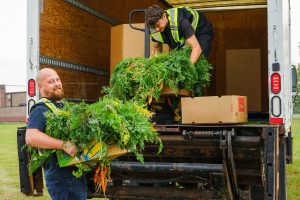
What started with an offer of five million pounds of potatoes has grown into Harvest Manitoba’s most ambitious plan yet: a food transformation centre aimed at cutting food waste and feeding more Manitobans.
Every month, Harvest helps feed 60,000 Manitobans, moving more than one million pounds of food through a network of 400-plus food banks and agencies in Winnipeg and across the province. Now, the organization is planning a new facility – targeted for completion by the end of 2028 – that would significantly expand its capacity to rescue surplus food, process fresh produce and deliver more nutritious meals across Manitoba.
“We need to be ambitious,” says Vince Barletta, Harvest Manitoba president and CEO. “We serve too many people to let them down.”
Harvest’s warehouse is often bursting at the seams, limiting how much they can accept – particularly large donations of fresh produce from Manitoba farmers – and how quickly that food can be processed before it spoils.
The challenge is part of a much larger problem.
In Canada an estimated $50 billion dollars worth of food is lost or wasted every year. In 2024-25, Harvest rescued 8.7 million pounds of surplus food, valued at more than $31 million, and redirected it to food banks and community programs. This is a fraction of the food that is wasted; much of it is tilled back into the ground or ends up in landfills or compost heaps.
There are a number of scenarios in which food leaks out of the supply chain, creating opportunities for redistribution through food banks. There are the “ugly veggies” not suitable for retail, oversupply at grocery stores, and donations from farmers, for example.
In the summer and fall, when Harvest receives root vegetables and other crops from Manitoba farms, the produce usually must be washed, sorted and packaged. These tasks are performed manually, and they are time consuming, which means some food spoils before it reaches food bank clients.
Harvest’s planned food transformation centre will significantly increase their food rescue and distribution abilities. State-of-the art equipment will automate manual processes, allowing fresh produce, and more of it, to move out the door faster. A new commercial kitchen will process fruits and vegetables into a state that can be efficiently stored and distributed year-round to hungry Manitobans.
“I think about the time of year when we have our pumpkins and squash coming in,” says Barletta. “You have to think of what the realities are of someone coming to a food bank. Someone is coming with a couple of kids, taking a bus in the winter: What are they going to do with a 10-pound pumpkin?
“If we can take those products, make pumpkin soup, make purees, that we can either send in bulk to agencies like soup kitchens or package them as individual meals that we can distribute through our food bank, we’ll get a lot better use out of the products and more nutritious food for families.”
Barletta says that food transformation activities are growing across the country. At the Leamington Regional Food Hub in Ontario’s greenhouse country, automation helps volunteers assemble 175,000 food baskets each year. At Daily Bread, Toronto’s largest food bank, a commercial kitchen prepares more than 100,000 meals annually. And there are talks among Canada’s food banks about the potential to share food across provinces — with the goal of improving national food security.
All of these activities reduce greenhouse gases and promote environmental sustainability.
“If food waste was a country, it would be the third largest emitter of greenhouse gases, after China and the United States,” says Barletta.
Helping more Winnipeggers find employment
The new facility will also allow Harvest to train more people for sustained employment. Currently, Harvest trains about 80 people a year in areas like forklift operations, food handling, order picking and general warehouse work.
“Then we work with 40-plus employers across the community, and nearly 80 per cent of those individuals get right into employment,” says Barletta.
At the new facility, the number of trainees will double, and new skills will be added to the mix, including operating advanced warehouse technology and developing kitchen skills that can help people find work in the restaurant industry.
As announced in October 2025, Harvest received early support from Farm Credit Canada, which has committed $500,000 to lay the groundwork. A feasibility study is complete, and the site selection process is underway, with the aim of nearly doubling their current space to 100,000 square feet, either at their existing site or a new location. Total project costs are estimated at $25 million.
Barletta says that fundraising efforts are underway, and he’s confident that they will reach their goal with support from governments, community and the philanthropic sector.
A game changer for Manitoba’s northern communities
Harvest Manitoba’s new food transformation centre will allow fruits and vegetables to be processed in Winnipeg and shipped year-round to the province’s remote communities.
Accessing nutritious foods is challenging in the north, where lack of all-weather roads means food often must arrive by air.
“The food transformation component will allow us to take the seasonal produce that we have here and make it available for year-round distribution by getting it into a frozen packaged format that’s easier to distribute to our remote communities,” says Barletta. “If we can help some of those lowest income folks to get access to more nutritious food for themselves and their children, that’s a good thing.”
The organization is the first food bank in Canada to participate in the Government of Canada’s Nutrition North program, which helps offset high shipping costs and expands access to essential foods in isolated regions.
Harvest continues to expand its efforts in remote areas, working with Indigenous and other community leaders and the federal government to advance food sovereignty. In 2024-25, Harvest completed more than 100 trips to deliver more than 450,000 pounds of food to northern and remote communities.