



A successful flavour combination is tough to achieve, but RRC Polytech’s Prairie Research Kitchen (PRK) has it down to a science.
The applied research facility — which has been operating on the 11th floor of the polytechnic’s Paterson Globalfoods Institute (504 Main St.) since 2014 — connects instructors and culinary students with industry professionals to develop alternative recipes and food combinations for market products, which, if successful, wind up on shelves in grocery stores and restaurant kitchens around Manitoba and beyond.
According to the RRC Polytech website, students work on projects from three different angles: the research and development associated with a product — “is it effective? Does it taste good?” — the business work that comes after, such as food photography and discussing resources with the client; and training both in-house and at network events.
Working with PRK can also open the door to government funding opportunities for clients, a perk which can make new, experimental releases from local companies far more achievable.
Since it opened its doors for business, the kitchen has developed enough recipes to fill up an entire cookbook, which can be found online.
Most recently, PRK has teamed up with BeeMaid Honey — based out of Manitoba and Northwestern Ontario — for the supplier’s newest endeavour: a new take on the “hot honey” craze, headlined by the New York-based Mike’s Hot Honey company, which blew up across
food-centred social media in early 2025.
“We were actually getting customers coming to us … the trend was really ‘hot’ in the U.S.,” says Shannon Bowden, brand and communications manager at BeeMaid.
Bowden says that BeeMaid aims to remain “100 per cent Canadian” with every project it does, and when tackling a trendy food such as this one, the challenge was how to create a new take on a popular product — in a way that’s entirely local, from start to finish — instead of just another version of the same thing.
“We weren’t looking to create something that had a really specific flavour profile,” she says. “It was exciting for us … this was the first one where it was going to be a larger scale… it was really an all- encompassing product from our organization.”
The two parties crossed paths at a food and beverage conference, when Bowden witnessed a presentation on PRK and the products that are developed there. Nearly immediately, there was a lightbulb.
“That’s just the kind of help we could use,” she says. “It seemed to me like (PRK) was the perfect group to chat with,” Bowden said. “Being right in our backyard made it so easy.”
There were a few roadblocks, at that point, she said, such as the fact honey responds very differently when mixed with just about anything, is hard to store, and can get expensive — “We’re careful with how we spend our dollars,” Bowden says, with a laugh. “(The funding) was a bonus we were so happy to have.”
“It really is a joint team effort,” says Mavis McRae, PRK’s director, adding that this project in particular was “quite an exciting time” for the students. One even had the chance to visit the plant in Ontario, where the new hot honey was processed, in order to understand how to proceed with the task at hand.
“It’s often restaurants that are leading food trends,” she added. “Our partnership with the culinary school helps shape some of the flavours … it’s fun to have that culinary side.”
The hot honey project took just over a year from concept to product, and involved many trails and experimentation with different ingredients. BeeMaid remained present along the way.
“Just to narrow down the preferred taste and profile of the product,” says McRae. “Each step has client engagement and understanding, hitting all those key points.”
“I’ve never done anything like this before … I was so impressed with the team,” Bowden says. “We (couldn’t) rush this. Let’s make sure we take that time … I appreciate that whole process.”
“We really do care about the clients’ success,” McRae says, adding that she enjoys being able to provide the assurances so that the “more fun types of products” are able to succeed.
The BeeMaid chipotle hot honey was introduced at a food and drink conference last year, and was met with an immediately positive reception. Bowden says that a few people had gone as far as to prefer it to its predecessor.
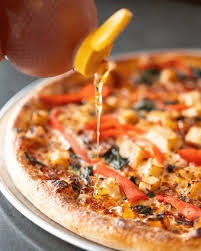 Although it has yet to make it to grocery stores, at press time, it has already found its home in local restaurants. Most notably, the Winnipeg-based Little Pizza Heaven, which was a major supporter of the product upon its completion and has since added it to its menu. The business was a great help, Bowden says.
“We refuse to send anything that doesn’t taste good out into the marketplace,” McRae says.
Alternative recipes are already being discussed, as well as cocktail and mocktails which use the new hot honey as a base ingredient. Perhaps this is only the spark, and the flame is still yet to come.