


 You’ve probably seen Taiv in action without realizing it.
From sports bars in Winnipeg to restaurant TVs across North America, an AI-driven platform is quietly changing what happens when live sports cut to commercial. Instead of generic ads – often for competitors or irrelevant brands – screens switch seamlessly to curated, location- specific content that benefits both venues and advertisers.
Co-founded in 2018 by CEO Noah Palansky, chief technology officer Jordan Davis and chief business officer Avi Stoller, Taiv officially launched in April 2021. Using artificial intelligence, it replaces traditional broadcast commercials in bars and restaurants with customizable, venue-specific ads, bringing new revenue for venues and highly targeted reach for brands.
And it all started in Winnipeg.
For Palansky, 29, the idea didn’t begin with a pitch deck – it started at a bar. While watching a Winnipeg Jets game one night, the broadcast cut to a commercial advertising beer specials at Boston Pizza. “It was cheaper to go get a beer at Boston Pizza than it was to get one at the bar I was sitting in,” he recalls.
With years of experience running marketing teams, the moment felt bigger than irritation.
“It clicked that this was one of the last places advertising hadn’t evolved,” Palansky says. “Every restaurant in the country is seeing the same ad during that broadcast, and it felt like a big opportunity to tailor it.”
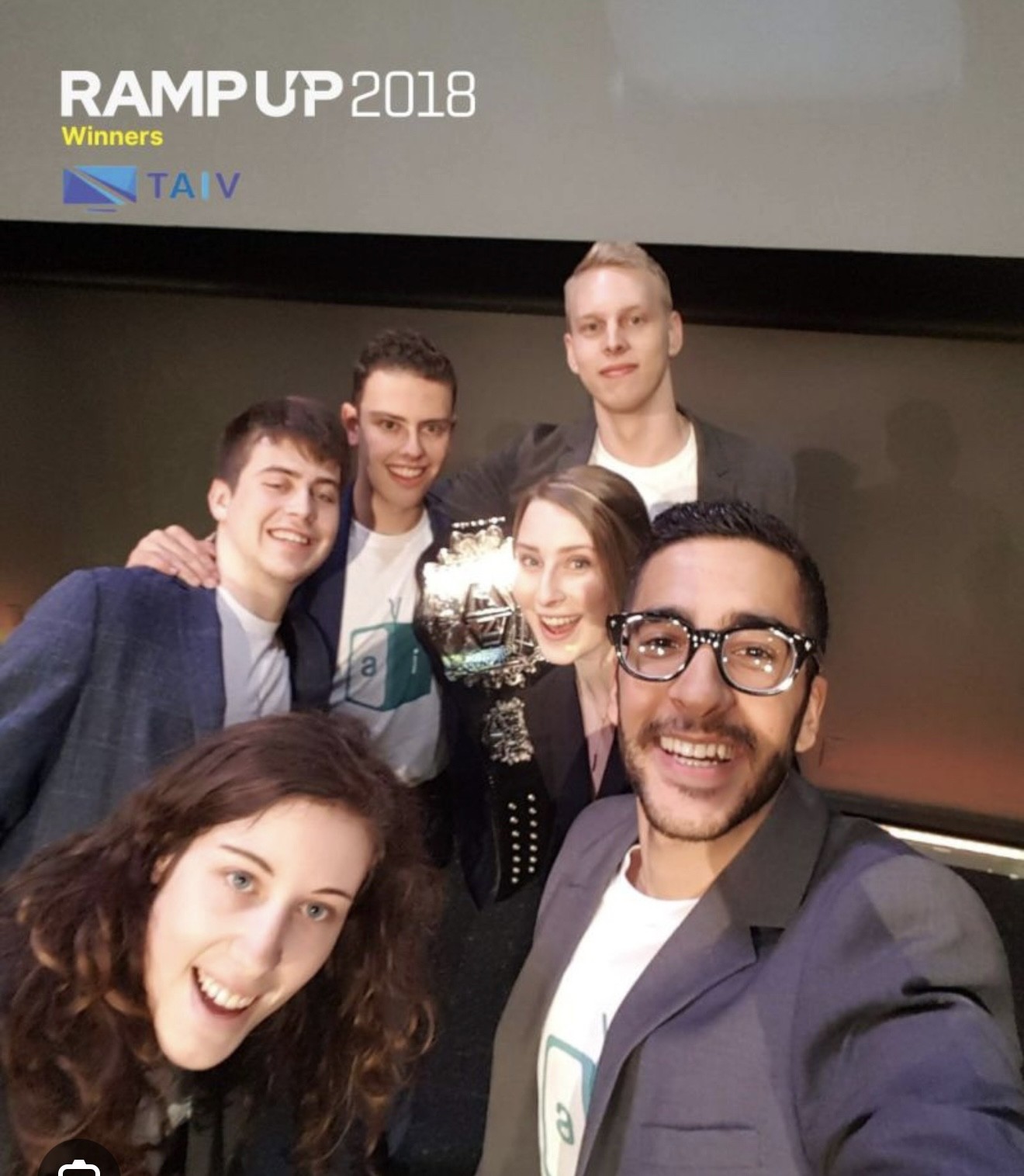
While digital platforms had embraced personalized, data-driven ads, in-venue television remained static – the same message playing in every restaurant, in every city. That spark carried Palansky and his team to North Forge’s RampUp Weekend, a 55-hour startup competition where entrepreneurs pitch ideas, form teams and present to judges – all in a single weekend. Taiv went on to take first place at the 2018 competition.
“Noah was so young but incredibly confident,” says North Forge CEO Joelle Foster, who served as a judge the year Palansky and his team presented. “By Sunday night, everything was thought through. It felt like a business that could hit the ground running on Monday morning.”
North Forge, a not-for-profit startup incubator, supports entrepreneurs with mentorship and coaching. RampUp Weekend, now entering its 16th year from April 10–12, has helped launch some of Manitoba’s most successful tech ventures.
“This is why we do RampUp,” Foster says. “Winnipeg has incredible tech talent and amazing engineering schools. We just need spaces where people feel safe to validate ideas and take the leap.”
From that early validation at RampUp Weekend, Taiv has grown rapidly, translating its original idea into a sophisticated AI platform now used across North America.
Last October, Taiv ranked the fourth fastest-growing company in Canada on Deloitte’s Technology Fast 50, posting revenue growth of more than 1,700 per cent over the past three years and achieving two-to-threefold growth annually since inception.
Much of that momentum is rooted in how the technology functions in practice. The platform is designed to operate quietly in the background. A small piece of hardware sits between a venue’s cable box and TV, and Taiv’s AI “watches” the broadcast. When it detects a commercial break or intermission, it automatically switches the feed. Instead of standard commercials, screens display tailored content: drink specials, trivia, events, music visuals and approved third-party ads. When the break ends, the live game resumes seamlessly.
“For the viewer, it just feels better,” Palansky says. “For the restaurant, it’s like hiring a DJ to switch the channel at exactly the right moment.”
The service comes at no cost for venues, and Taiv installs and maintains the hardware. Restaurants benefit in three ways: promotion, revenue and control – they can showcase their own offerings, earn from third-party ads and curate exactly what appears on their screens.
For Ryan Cox, general manager at Original Joe’s in Winnipeg, signing on with Taiv was an easy choice.
“It seemed like a no-brainer,” Cox says. “It’s free for restaurants, helps increase our sales, highlights our promotions and gets people talking about our brand. We can show our own promotions instead of competitors or nonsensical commercials.”

That control has translated directly to customer engagement. “We’ve had guests undecided on what to order, see an ad on our TVs and ask, ‘What was that drink? That looked amazing – can I order that?’”
Cox notes that Taiv captures attention when customers usually tune out. “Most people go on their phones during commercial breaks, but these ads are relevant because everyone’s already in the restaurant and can benefit from seeing our specials.”
Just as importantly, it removes a long-standing frustration. “No one wants to see ads for the competitor across the street on your TVs,” Cox says. “Taiv only shows your content, and you can curate it however you like.”
That level of control is core to Taiv’s value proposition. As Palansky explains, television commercials were the last part of a venue’s customer experience that operators couldn’t – until now. “We give that control back to them,” he says.
For advertisers, Taiv is just as appealing. Brands can run highly targeted campaigns during live sports, reach specific cities or types of venues and pay on a cost-per-thousand basis – similar to Facebook or Google, but in a real-world, engaged setting. Taiv’s advertising clients range from Coca-Cola and Pepsi to ESPN, BMW, Toyota, Bacardi and Budweiser.
Last summer, the company raised $14.4 million in Series A funding, bringing its total funding to more than $26 million. Palansky and Davis were also recently named to the Forbes 30 Under 30 Class of 2026 in Marketing and Advertising.
Taiv now operates in more than 4,000 locations across the U.S. and Canada, with major footprints in New York, Chicago, Miami and Los Angeles. Winnipeg remains its only Canadian city, with about 35 venues. The U.S. focus was partly timing – Taiv launched during COVID,
when Canadian restaurants were largely closed – and partly structural.
“Ad buying doesn’t really cross borders,” Palansky says. “U.S. and Canadian budgets are completely separate.” When the company expands further in Canada, it will likely be nationwide.
Despite its U.S. scale, Taiv has kept its roots firmly in Winnipeg. Of roughly 85 employees, about 80 per cent are local. That local presence, Foster says, is part of the city’s advantage. Winnipeg offers a strong talent pool and supportive systems for startups, including the Small Business Venture Capital Tax Credit, which provides up to 45 per cent tax relief for investors, as well as programs like the Innovation Growth Program and Research Manitoba funding.
“Winnipeg is proof that globally scaling tech companies can be built here,” Foster adds. “Taiv is a perfect example.”
With an advertising audience of roughly 15 million viewers each month and a customer retention rate of 99 per cent, Taiv is firmly in growth mode. The company is actively hiring, especially software engineers, as it focuses on scaling across North America.
“We’ve validated the business,” Palansky says. “Now it’s about how big we can make it, and how fast.”
For Winnipeg restaurant owners curious about joining, Taiv currently operates with waitlists – but interest is encouraged.
“This city is special to us,” Palansky says. “If someone reaches out, we’ll absolutely talk.”
Chances are, the next time you’re watching a sports game in a restaurant, Taiv is already at work behind the screens.