



Manitoba has a strong tradition of family-led companies, where leadership often passes from one generation to the next. It’s a pattern that continues across the province, with several major firms today guided by successors who grew up immersed in the businesses they now lead.
Across Canada, this moment carries historic weight. According to a 2022 Canadian Family Enterprise report, family-owned companies make up 63 per cent of all private-sector firms nationwide, and 60 per cent are expected to undergo ownership transition in the next decade. Yet only about half of those businesses intend to transfer ownership within the family, while 36 per cent of owners say they may need to look outside the bloodline due to lack of interest or experience.

Steve Beauchesne, CEO of Family Enterprise Canada, says the country is entering “one of the most significant transitions in Canadian economic history.”
“Over the next decade, ownership, control and wealth in almost 75 per cent of small and medium Canadian family businesses will move from one generation to the next. When that transition is well planned, communities keep jobs, families keep their sense of purpose and the business is in a stronger position to grow. When it is not, value can disappear very quickly.”
He adds that while many people think succession is about tax or legal strategy, experience shows otherwise.
“Families that do well are intentional. They start early, they build governance and they invest in preparing the next generation. They treat succession as a long-term process, not a single event.”
Many of Manitoba’s best-known firms are now led by their fourth or fifth generation. Among the most notable transitions is the one this past August at James Richardson & Sons Ltd. (JRSL), where Thor Richardson succeeded his father, Hartley T. Richardson, after 32 years at the helm.
JRSL — the largest privately held company in Manitoba — is also one of the province’s oldest. Founded in Winnipeg in 1857, it has remained in Richardson hands for nearly 170 years, an almost-unmatched run in Canadian business.
It is an impressive lineage, but not the only one in the province. Bockstael Construction, founded in 1912, also moved into its fourth generation this year when Dan Bockstael became CEO. He joins a leadership team that includes Nick Bockstael, chief operating officer; Sarah Anderson, director; and John Bockstael, chairman.
For the Bockstael family, legacy is more than history, it’s a guidepost. With several generations involved in day-to-day leadership, the firm continues to draw on its past while adapting to an industry undergoing rapid change.
Yet while the Richardsons and Bockstaels make succession appear seamless, many family businesses face a more complicated reality.
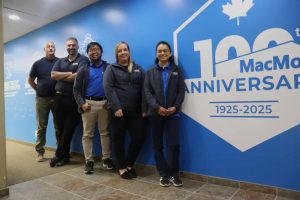
“Succession is already a big concern and will only grow more pressing,” says Arthur Roy, president of MacMor Industries, a century-old industrial service company in northwest Winnipeg.
Roy knows the landscape well. MacMor operated as a family-run business for decades and he began working there as a teenager under his father, Jean-Marc. But in February 2025, the Roy family shifted from owners to shareholders after the company was acquired by Ficodis, a Quebec-based industrial
distribution group.
“What MacMor looks like today is nothing like what it’ll look like in 10 years,” Roy says, noting the sale was driven by plans for national growth. Despite the change, he says the company maintains its identity.
“We still have a lot of fun. We still take a lot of pride in our brand,” he says, noting the company continues to uphold the “family-owned feel.”
Roy says many Manitoba family businesses are struggling with what comes next. Ficodis has made succession support a priority, buying family-operated companies while preserving their culture and history.
MacMor is now part of that effort. Roy says he is currently speaking with one business that has no family members willing or prepared to take over, a situation increasingly common across the province.
“There’s a lot of emotions,” he says, noting founders often fear losing the “people-over-profit” reputation they’ve spent decades building.
According to Winnipeg law firm TLR, 30 per cent of family businesses do not survive to the second generation. Lawyer Philippe Richer says this isn’t due to lack of care for legacy, but to unexpected events (such as a sudden retirement, illness or death) that can unravel even long-established plans.
Richer stresses that clear governance and a defined roadmap are essential. Third-party sales, employee buyouts and intergenerational transfers can all work, he says, but each comes with different questions about control, culture and future direction.
Workers are increasingly part of the conversation, too. According to RBC’s 2025 North American Office Report, only 38 per cent of surveyed workers are satisfied with current succession plans and just 28 per cent feel confident about next-generation education, underscoring the communication gap businesses must navigate.
Institutions have begun responding. The Asper School of Business at the University of Manitoba dedicated its annual Rod Senft business conference in November to “navigating the new realities for family business,” exploring everything from Canada-U.S. trade tensions to worker co-ops and employee ownership.
Co-ops have stepped in as a succession solution in the past. Pollock’s Hardware, a century-old North End store, became a co-op in 2007 after owners Wayne and Lois Cash struggled to find a buyer. The store closed briefly, but community backlash spurred residents to form a cooperative and purchase it.
“A lot of people don’t have kids that want to do what Mom and Dad did,” Roy says.
It’s a simple truth shaping a major shift in Manitoba’s business landscape. For many family enterprises, the challenge is clear — embrace new models, new leadership paths and new definitions of legacy. Those that plan ahead may find succession isn’t an ending, but the start of an entirely new chapter.


