

ASK someone what Manitoba’s protein industry produces and they might start with pork, beef or peas. The full answer is a lot longer.
The province produces animal proteins including pork, beef, poultry, dairy, eggs and fish, along with plant proteins from pulses, canola, soy, hemp, flax and oats. Those crops can also become protein concentrates, isolates and flours used in baked goods, snack foods, dairy alternatives and fortified beverages. Emerging areas like insect and cellular protein are part of the mix, too.
“Manitoba’s protein industry covers the full chain from what we grow and raise here to what gets processed, packaged and shipped out,” says Keisha Paul, program facilitator with ProteinMB, a division of Canadian Manufacturers & Exporters.
Manitoba is home to the world’s largest pea processing facility, the world’s largest hemp processing company, North America’s first canola protein processor and Canada’s largest bacon plant.
There’s a growing push to keep more of that processing in Manitoba, rather than shipping crops and commodities elsewhere to be turned into higher-value goods.
“Canada’s growing food production and value-added agriculture sector means we can do more than just grow the protein crops the world is looking for,” says Tyler Groeneveld, CEO of Protein Industries Canada, one of the federal government’s national innovation clusters focused on plant protein. “We can make them into high-quality ingredients and food products, right here at home.”
Since its launch in 2018, Protein Industries Canada has co-invested in 22 projects led by Manitoba partners, representing $208 million in total project investment. The projects have created additional demand for Manitoba-grown peas, canola, oats, wheat, soybeans and faba beans. That investment is part of a much larger food manufacturing sector Manitoba has spent years building.
Paul points to a wave of private investment, too. Roquette built its pea protein facility in Portage la Prairie, HyLife expanded in Neepawa, Maple Leaf Foods opened its Bacon Centre of Excellence in Winnipeg and Winkler Meats expanded its operation in southern Manitoba.
Even so, Paul says Manitoba is still leaving value on the table.
“We’re seeing more of it, but not enough of it yet,” she says. “A lot of what Manitoba grows and raises still leaves the province as a raw commodity, gets processed somewhere else and comes back as a finished product someone else profited from.”
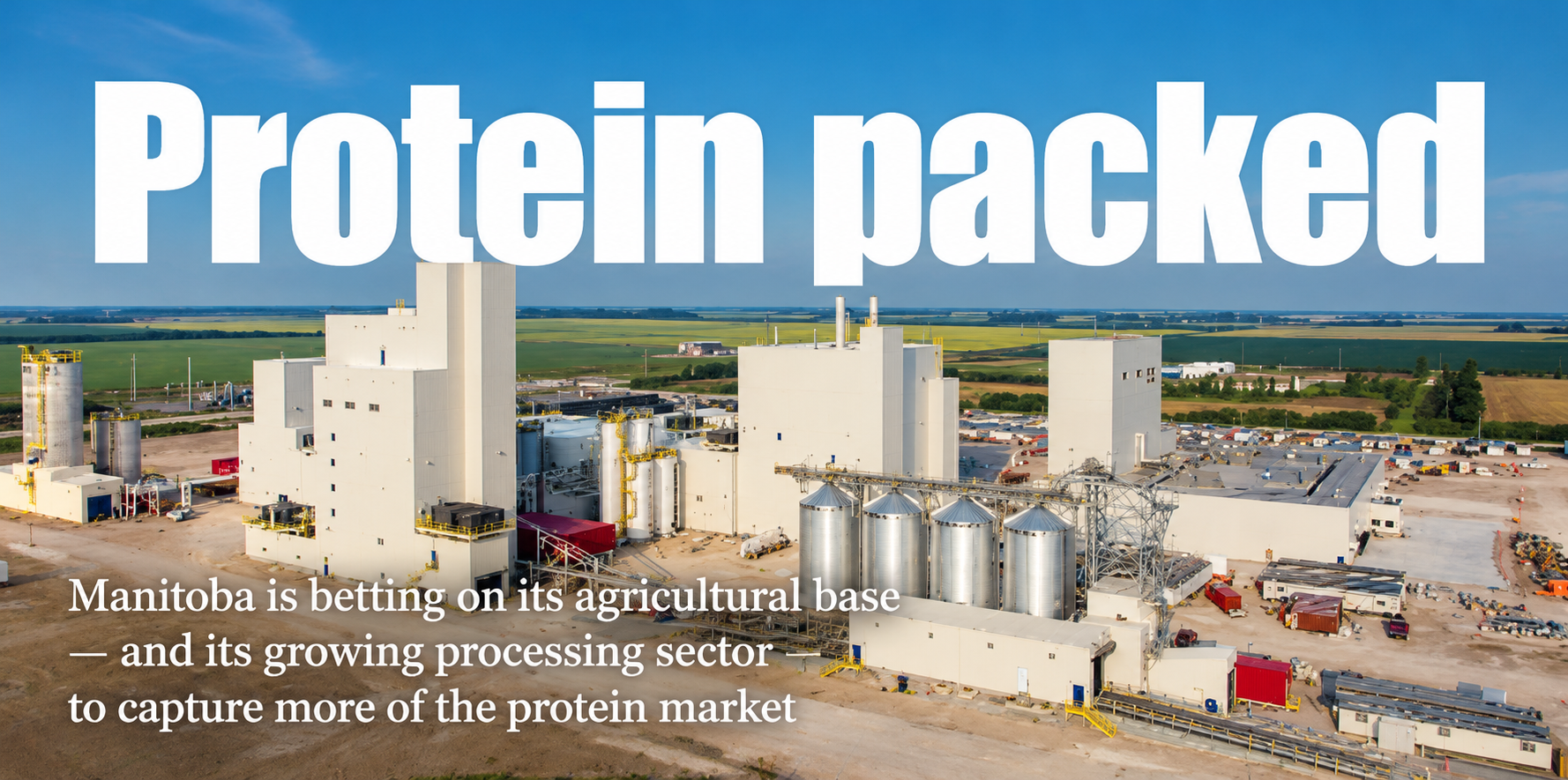
Roquette’s Portage la Prairie operation is a large-scale example of what that processing can look like.
The plant opened in 2021 and has capacity to process 125,000 tonnes of yellow peas annually. At full production, the company says it can source peas from as many as 300 farms. Inside the facility, yellow peas and fava beans are processed into protein, fibre and starch ingredients used by food manufacturers. The plant handles conventional and organic production and has Halal, Organic and Kosher certification.

“At our Portage facility, we enhance the unique properties of the constituents of plant-based raw materials, yellow peas [and] fava beans, to produce a range of healthy and functional ingredients across proteins, fibres and starches,” says James Bozikis, Roquette’s head of communications and public affairs – Americas.
What customers want from those ingredients is also changing.
Pea protein was already well established in sports and nutrition products such as protein powders and shakes. Demand later grew in plant-based meat and dairy alternatives.
Today, Roquette says demand is broadening into everyday foods.
“Consumers increasingly want more protein in foods they already know and enjoy. Things like breads, pastas, bars, snacks and beverages, rather than having to turn to traditional protein supplements,” Bozikis explains.
He says the growing use of GLP-1 medications is adding to that demand, with consumers looking for more protein and nutrition in smaller, nutrient-dense portions that still taste good.
Longer term, Bozikis expects consumer expectations to keep getting more precise – it won’t be enough for a product to simply be “high in protein.” Consumers will look for specific nutritional benefits, taste and convenience together, and he points to Manitoba’s agricultural base and processing infrastructure as strengths to build on.
Protein is only part of what processors can get out of the peas, though. Pea starch adds texture, crispness and moisture retention to baked goods and snacks, and pea fibre helps with water binding and texture in baked goods and plant-based meats. Roquette is also working with Protein Industries Canada and Pulse Canada to find additional uses for those co-products.
That kind of work is part of a bigger push to build out the province’s processing capacity across the sector.
Manitoba is well positioned geographically to grow food processing and reach urban markets in Ontario and Quebec, Groeneveld says. The opportunity, he adds, is to process more of what’s already grown in the province instead of shipping it elsewhere.
“By making more from Canadian crops, on Canadian soil, Manitoba’s food production and value-added agriculture sector can help grow the country’s GDP, create new innovation-based jobs in communities across the province, provide new food options for families here and around the world, and improve the sector’s sustainability,” Groeneveld says.
Plant protein is one part of a much larger industry.
Food manufacturing is Manitoba’s largest manufacturing sector. Sales reached a record $9.46 billion in 2025, up from $6.11 billion in 2020, according to the provincial government, with pork and canola oil among the province’s leading food exports.
Japan has become an important market for Manitoba pork, particularly fresh chilled pork. Paul says Japanese buyers have specific requirements around taste, marbling and shelf life, and Manitoba producers have spent years developing herds, feed programs and processing systems to meet them.
“There’s Manitoba pork on grocery shelves in Tokyo that was raised, fed and cut here to a Japanese customer’s specification,” she says. Paul points to HyLife as a Manitoba example. The La Broquerie-headquartered company bought its Neepawa processing plant in 2008 and built itself into Canada’s largest exporter of fresh chilled pork to Japan, developing a branded pork program for Japanese consumers and opening a restaurant in Tokyo to build the brand there. The company has also attracted major international investment, including a stake held by the Japanese trading house Itochu. Today, HyLife is one of the province’s largest employers and ships products to more than 20 countries.
Finding more customers outside the U.S. has become increasingly important for Manitoba processors, she says.
For decades, the U.S. was the obvious market. It’s close, its supply chains connect directly to Manitoba’s and demand has historically been reliable. But that’s changed: tariffs, the return of country-of-origin labelling and state-level rules like California’s Proposition 12, which sets animal housing requirements for pork sold in the state, have made the American market less predictable. A review of the Canada-United States-Mexico free trade agreement means uncertainty will likely continue through at least the next year.

“The U.S. will remain our largest customer,” Paul says. “But companies are no longer comfortable being dependent on one market.”
She sees opportunities in Japan, South Korea, Southeast Asia and the European Union.
Closer to home, there’s another issue limiting how much value Manitoba can capture. Paul calls it “the gap in the middle.”
The province has plenty of primary agricultural production and several large processors, but the capacity between those two points is thin, she explains. A company might develop a product and find customers for it, then struggle to find anywhere in Manitoba that can produce it at scale.
“Co-packing and contract manufacturing come up constantly in those conversations,” Paul says. “Closing that gap is the single biggest thing that would move the sector.”
Groeneveld also sees further processing as central to Manitoba’s opportunity. Looking ahead, he points to Manitoba’s role in what he calls Canada’s “Make It Here” potential – turning more of the province’s protein crops into finished food and ingredients. He says the next step is attracting strategic investment, backed by a strong regulatory system and cooperation across all levels of government. “Municipalities, provinces and the federal government all need to operate with a sense of urgency and cooperation,” he says. “With all of these elements brought together, Manitoba can be a leader in helping Canada seize its full food production and value-added agriculture potential.”
Manitoba already has the crops, livestock and a significant food manufacturing base. For Paul, the question is how much more of the processing can happen here.
“Every step we do here is value that stays here: jobs, tax base and a stronger position for our producers,” she says.
She would like to see Manitoba become one of North America’s leading protein-processing jurisdictions, with more processing capacity, enough workers to support it and a broader range of export customers.
Ultimately, she says, the aim is for Manitoba to be known for “what we make and not just what we grow.”