

 When food processing facilities look to reduce energy waste, refrigeration systems are often where the greatest opportunities lie. In energy-intensive environments such as poultry processing, cooling is integral to every facet of production.
At the Dunn-Rite Food Products facility in Winnipeg, refrigeration is more than a utility system — it’s essential to maintaining food safety, product quality, and efficient production. As processing demand continues to grow, facilities across Canada are facing increasing pressure to
expand capacity while managing rising energy costs.
To address this challenge, Dunn-Rite partnered with Efficiency Manitoba through its Custom Energy Solutions (CES) program to modernize its refrigeration system with variable frequency drive technology. By improving how compressor capacity responds to real-time cooling demand, the project demonstrates how targeted efficiency upgrades can reduce energy consumption, improve system performance, and support long-term operational reliability in food processing facilities.
CANADIAN POULTRY – DUNN-RITE FOOD PRODUCTS
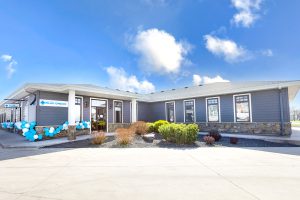
Dunn-Rite Food Products, owned by Sunrise Farms, operates a poultry processing facility in Winnipeg, Manitoba. Sunrise Farms is a Canadian family-owned group of companies that has grown from its origins in poultry production, including hatchery operations, farming,
primary processing, and further processing, into a national distributor of protein products across Canada.
With facilities in British Columbia, Alberta, Manitoba, and Ontario, Sunrise Farms has established a national presence while maintaining its commitment to quality and family values. The company employs around 3,600 team members who help deliver premium food products across Canada.
Refrigeration is central to operations at Dunn-Rite’s Winnipeg facility. As demand increased, finding new solutions for reliable and energy-efficient cooling systems became even more important.
KEEPING IT COOL WITH VFD TECHNOLOGY
A variable frequency drive (VFD) controls the speed of motors that power equipment such as fans, pumps, and compressors. By adjusting the frequency and voltage supplied to the motor, a VFD enables refrigeration equipment to match cooling output to the facility’s actual
needs throughout the day.
As cooling demand naturally fluctuates with production schedules, facility occupancy, and environmental conditions, refrigeration systems do not always need to operate at maximum output.
Traditional refrigeration compressors often rely on mechanical unloading methods, such as slide valve unloading, to reduce cooling capacity during lower-demand periods. While effective, this approach can still consume more energy than necessary because the motor continues
to run at full speed.
A VFD improves efficiency by slowing the compressor motor when cooling demand is low. Instead of continuously operating at maximum speed, the compressor can adjust gradually and automatically based on conditions inside the facility. This allows the refrigeration system to operate more efficiently while maintaining consistent performance.
For food processing facilities, this technology can provide several important operational benefits. Reducing unnecessary energy consumption helps lower operating costs while supporting more stable temperature control throughout the facility. Because the equipment is not constantly operating at full speed, VFD systems can also help reduce wear on mechanical components, supporting improved long-term reliability and maintenance performance.
Most importantly, VFD technology offers a practical, achievable solution for facilities seeking to improve efficiency without fundamentally changing their operations.
SMARTER COOLING FOR EXPANDING FACILITIES
As Dunn-Rite expanded operations at its Winnipeg facility, additional refrigeration compressor capacity was needed to support increasing production.
“We knew that increasing refrigeration capacity would support production growth, but it wouldn’t necessarily improve efficiency,” says Craig Perrett, Industrial Systems Engineer at Efficiency Manitoba. “Without fully exploring optimization, the expansion would likely raise energy use and operating costs.”
To address this, Dunn-Rite partnered with Efficiency Manitoba through its CES program to improve system performance.
“The focus shifted from simply producing more cooling to using cooling more efficiently,” says Perrett.
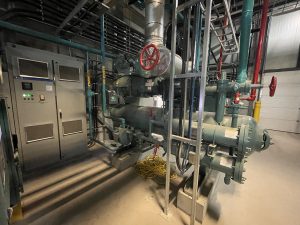
The facility’s cooling system is served by an ammonia refrigeration system, and the expansion allowed for two additional refrigeration screw compressors to serve increasing cooling demands. Traditionally, systems like this rely on slide-valve unloading to manage capacity. This
reduces output but not motor speed, so compressors still use significant power even at partial load.
For this project, a VFD was added to one of the new compressors, which is now used as a trim machine. The upgraded system uses a more efficient control strategy, reducing speed to 720 rpm before using slide-valve unloading. This approach better matches real-time cooling
demand and improves efficiency during load fluctuations.
The upgraded refrigeration system at Dunn-Rite meets higher production needs, reduces unnecessary energy use, and improves operational responsiveness, resulting in measurable annual energy savings.
MEASURED RESULTS AND VERIFIED SAVINGS
To validate performance, the system was analyzed using operational data collected at one-minute intervals over two weeks. Compressor performance was compared to the original scenario to assess the impact of VFD integration.
The analysis confirmed that Dunn-Rite achieved projected annual energy savings of 210,000 kWh. In addition to these savings, the project achieved a simple payback period of just over two years, accounting for both energy and non-energy benefits. Furthermore, the project qualified for a $31,000 incentive from Efficiency Manitoba’s Custom Energy Solutions program, directly improving the project’s financial outcome.
Most importantly, these improvements were made without disrupting daily production. The facility operated as usual during implementation, demonstrating the practicality of integrating efficiency upgrades into existing systems.
HOW CUSTOM ENERGY SOLUTIONS SUPPORTED THE PROJECT
“Working with Efficiency Manitoba made a real difference in this project,” says Lloyd Harms, Maintenance Manager, Dunn-Rite Food Products. “Their team helped us identify practical energy-saving opportunities in our refrigeration system and guided us through available financial incentives. Having both technical insight and program support made it much easier to move forward with confidence.”
Unlike traditional rebate programs, CES is based on customized engineering analysis and verified performance. Incentives are tied to measured savings, calculated at $0.25 per kWh of electricity saved and $0.30 per cubic metre of natural gas saved, so greater energy reductions receive greater financial support.
The program supports a wide range of industrial systems, including compressed air, pumps, fans, heat recovery, steam systems, ventilation, and variable speed drives. This approach helps facilities find efficiency opportunities that integrate with existing operations without affecting reliability.
By combining technical expertise with performance-based incentives, CES reduces implementation barriers and supports confident decision-making for facilities considering energy upgrades.
SUPPORTING MANITOBA INDUSTRY
Across Manitoba, industrial facilities are addressing rising operating costs and the need for greater efficiency while remaining competitive. The main challenge is implementing energy-saving measures that align with production needs. The Dunn-Rite VFD project shows how targeted equipment upgrades can deliver significant results with minimal disruption. More broadly, the project highlights the value of collaboration between industry and programs like Efficiency Manitoba’s Custom Energy Solutions. Combining technical expertise and financial support makes efficiency improvements more accessible and impactful.
For facilities like Dunn-Rite Food Products, this support can be the difference between maintaining current systems and making meaningful progress toward long-term operational efficiency.
Learn more about Efficiency Manitoba’s Custom Energy Solutions program at efficiencyMB.ca/industrial.