


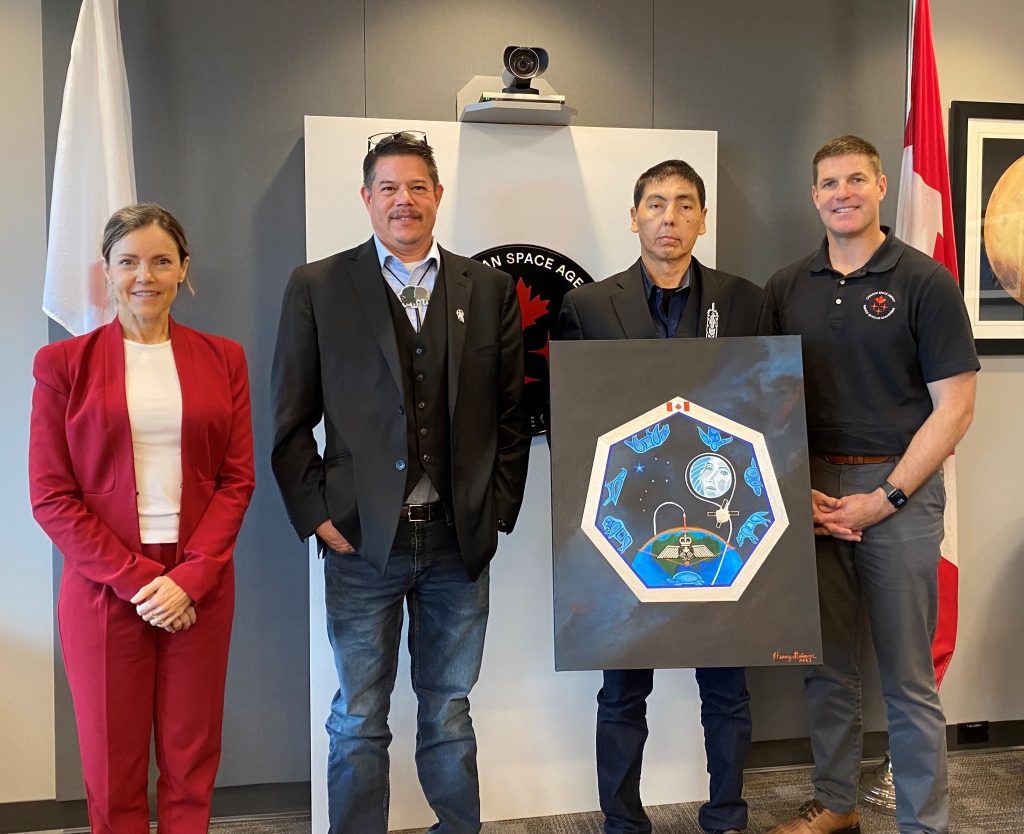
It’s hard to imagine anyone in Manitoba was more excited than Henry Guimond when Canadian astronaut Jeremy Hansen and the crew of Artemis II launched into space in the spring.
Guimond, an Anishinaabe artist born and raised in Sagkeeng First Nation, was commissioned to create a specially designed patch Hansen wore on his bright orange Orion Crew Survival System suit during the high-profile mission around the moon. He was glued to his television during the launch and says the visuals sent a shiver down his spine.
“It was really breathtaking to see that spacecraft light up like that and go,” he says. “My heart kind of skipped a beat when I saw it going up and how bright it looked.”
Guimond was chosen after Hansen contacted him through Sagkeeng’s Turtle Lodge International Centre for Indigenous Education and Wellness. The artist admits he was initially puzzled by the request.
“I got a call that an astronaut wanted a painting. It kind of blew my mind,” he says, laughing. “I didn’t know what kind of painting. I thought he just wanted artwork.”
A design rooted in culture and space
 It took Guimond more than 200 hours to complete the design. He produced two preliminary drafts, which Hansen incorporated into the final patch worn on his suit. The design features the Seven Sacred Teachings represented through animal imagery arranged in a heptagon. It also includes Grandmother Moon, Hansen’s astronaut wings and a bow symbolizing Artemis, the Greek goddess of the hunt.
“I was pretty happy with it,” Guimond says. “I wanted to add some mechanics, but I didn’t want a rocket. The bow and arrow made sense because that’s what Artemis would carry.”
He says Hansen responded positively to the final design.
“He was really proud of how it worked out. He liked the mechanics of the bow,” Guimond says. “It makes me proud that he’s wearing it.”
From Sagkeeng to space agencies in Quebec
Although Guimond did not travel to space, he says the experience made him feel part of the mission. He later visited the Canadian Space
Agency headquarters in Longueuil, Que., where he delivered the original artwork used to create the patch.
“We went on a tour. It’s a beautiful place,” he says.
He also shared a dinner with Hansen during the visit. It marked the second time the two met. Their first meeting took place in September 2024, when Hansen visited Manitoba as part of a Canadian Space Agency tour.
During that visit, Hansen spent several days in Sagkeeng First Nation, where he took part in a four-day fast, participated in a sweat lodge and received Indigenous teachings in preparation for his mission.
“I asked him how it felt knowing he was going to the moon,” Guimond says. “He said he was preparing himself and willing to do it for humanity. I thought he was really brave.”
Hansen later reflected on the experience, saying the community had made a lasting impression.
“They’ve done a lot for me, they’ve given a lot,” Hansen said. “They want to be part of it and help, and hopefully their efforts will help communicate the beauty and depth of Indigenous knowledge.”
Art inspired by land and sky
Much of Guimond’s work is rooted in Indigenous teachings but space has long been part of his artistic inspiration. The sun, moon and stars frequently appear in his work.
“The sun represents the Creator, the giver of life. The moon is the grandmother and the stars are the star people and where we come from,” he says.
Two of his paintings are on display at the Canadian Museum for Human Rights.
Guimond, who also works as an architect and building contractor, says the exposure from the Artemis II project has led to new opportunities. He has received international media requests and inquiries about commissions. Anyone interested in contacting the artist can email Turtle Lodge at theturtlelodge@gmail.com.