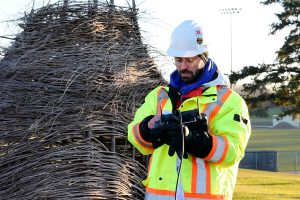



 Railside at The Forks broke ground this January, kicking off the first phase of a development that will transform two underused surface parking lots into a downtown housing hub.
Since its 1987 inception, The Forks Renewal Corporation has always envisioned a residential component for the site. With recent strategic planning and public consultation, the challenge has been figuring out how to integrate housing into this popular Winnipeg destination, which sees over four million visitors a year.
According to Adam Dooley, corporate communications director for The Forks, staying on brand with the Railside project means delivering “more of The Forks.” This mixed-use plan helps address the city’s urgent need for more housing, while also making space for “more shops, more restaurants, more places to hang out, more art, more activities, more walkways.”
Because The Forks is an important historic site that has been used for millennia as a meeting place, it’s also crucial for Railside to encourage connection and community by keeping things at a human scale. “One of the original ideas was to have three skyscrapers, and that was kyboshed, I think for good reason,” Dooley says. “I don’t think it fit the space very well.”
Railside’s current plan is a three-phase process stretching into 2040. “We’re doing Phase 1 over the next two years, which will feature up to ten buildings that will add approximately 350 residential units, so we’re expecting 600 to 700 people living on-site,” Dooley relates. All the structures are medium-rise—between four and six storeys—with main floors designated for retail and services.


Future commercial tenants will include local indie shops and eateries, as well as a daycare centre. Leasing is still underway, but Dooley is hoping The Forks will be able to sign a medical clinic and a small grocer. All this business activity will help keep Railside’s street level humming while boosting the downtown economy. According to a Deloitte LLP report, once complete, the new development will contribute about $23 million in GDP annually and create about 215 full-time jobs.
Financing will come mostly through private investment, along with funding from the three levels of government. “We’re expecting total investment in Phase 1 will be somewhere north of $150 million for all ten buildings” Dooley says. “We have tax increment financing through the city and province and up to $16 million in public space improvement.”
Phase 1 of Railside involves seven developers and six architectural firms, which makes for design diversity. The site is planned so the buildings work together to provide sheltered public plazas, courtyards and pedestrian throughways, but within that overall vision, each structure is unique. “We didn’t want anything that was humdrum or bland,” Dooley suggests, and chosen designs include everything from a brick-fronted building that references Winnipeg’s historical Warehouse District to a standout structure with a “quilted” white façade and a glowing pink entrance courtyard.
Railside will also offer a range of housing options. Of the nine buildings confirmed so far, one will be a condominium and eight will be apartment buildings, with units ranging from ultra-compact micro-apartments to three-bedroom suites meant for families.
There’s an emphasis on affordability. Parcel 9, developed by The Forks Renewal Corporation, will feature 46 units deemed affordable, with 18 one-bedrooms renting at less than 69 per cent median market rate. As well, 28 “deeply affordable” two- and three-bedroom units will be provided for low-income single parents. In numerical terms this means rent-geared-to-income rates capped at 30 per cent of a household’s gross income.
These varied options are meant to bring in a varied demographic, which supports social sustainability, another key part of The Forks’ mandate. “The people this development will appeal to will probably be a mix of young professionals, some lower-income families and some empty nesters who want to downsize and want to live in a cool space,” Dooley says.
“We want a diversity of people living here,” he adds. “Studies show that in great cities around the world when you have diverse types of people and income levels living in proximity to each other it makes for a healthy community.”
Another crucial part of The Forks’ approach, and one that could draw in younger tenants, is environmental sustainability. “These are energy-efficient buildings, and we’re anticipating that one or two will be on geothermal,” Dooley says. Railside residents will benefit from The Forks’ recycling and composting programs, part of the site’s target-zero goal for waste.
Railside is also designed to be a walkable neighbourhood, with amenities like good coffee and craft beer right on-site. As well, there will be perks for residents interested in carsharing. “We’re marketing this to people who are interested in other ways of getting around the city,” Dooley explains. That means a partnership with Peg City Car Co-op, with options that include both reserved round-trip FIX cars and free-floating FLO cars. Dooley also points to a proposed plan to repurpose Union Station as a rapid transit hub.
“Originally this was just an old railyard,” Dooley says. With construction underway, Railside is aiming to be both a natural extension of The Forks and an innovative new mode of downtown living.
Compact, clever design
One of the first buildings going up with the Railside project is a four-storey structure offering 16 short-term-rental micro-apartments, designed by 2Architecture and developed by Burrow. While these units are very compact, several coming in under 200 square feet, clever design details like custom millwork, pull-out surfaces and concealed storage keep things sleek and functional. Residents also have access to a landscaped rooftop and communal indoor spaces.
“We feel there’s a demographic that needs this type of housing, to be able to rent a place month to month,” says Andre Silva, principal architect with 2Architecture and a founding partner of Burrow. Geared to business travellers, tourists, students and young professionals, these furnished units will be supported by Burrow’s tech-forward approach to property management.
With a concierge app that allows tenants to access fixed-fee tiers of services, Burrow covers everything from meal box deliveries to car shares to laundry service to pet grooming. “We want to use technology to our advantage to remove some of the heavy burdens of living,” explains Silva. “We’re trying to attract people who don’t necessarily want to buy sofas and drive cars. They just want to live in a place rich with amenities and get their services provided.”