


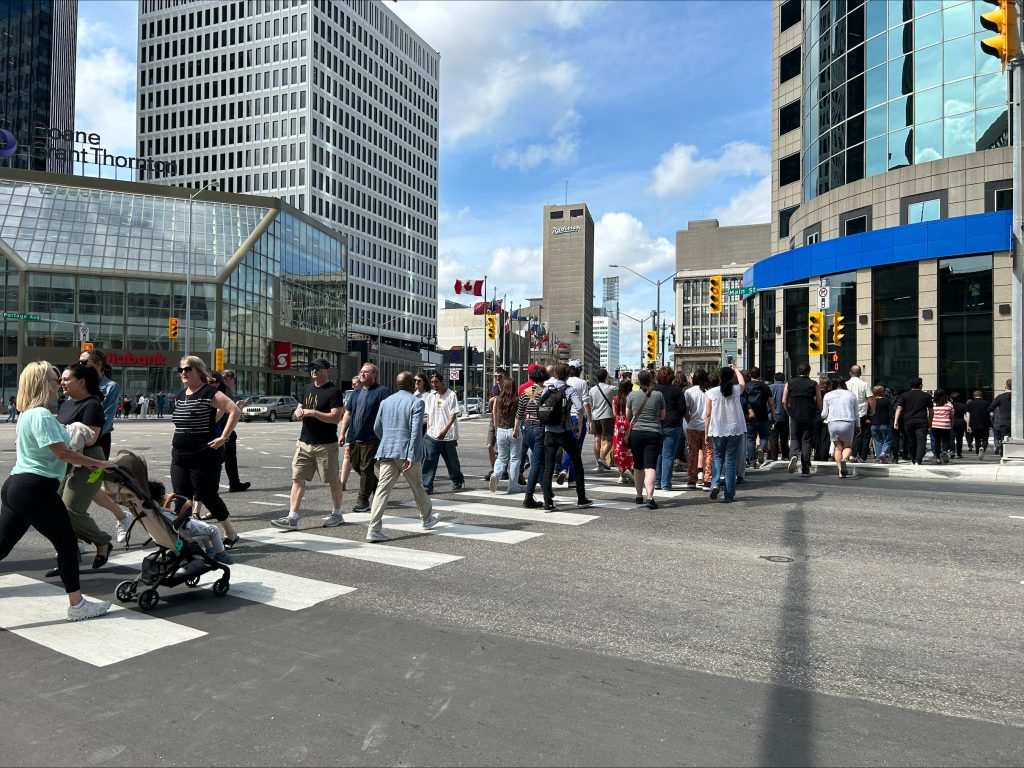
It’s been one year since Portage and Main opened up to pedestrian traffic for the first time in nearly a half-century, but aside from the initial
hoopla it’s been pretty quiet at Winnipeg’s most famous intersection.
Vehicles pull up to red lights, people cross, lights turn green, people stop and vehicles move. Repeat.
The naysayers’ predictions of death and dismemberment from the never-ending stream of accidents have not come to fruition and Portage and Main has settled in to being just another intersection. Nobody is happier about it all than its primary architect, Mayor Scott Gillingham.
“I think Portage and Main opening has been very positive for the city and certainly for the downtown. Functionally, the intersection is operating really well. Traffic is flowing smoothly. According to reports last year, close to 3,500 people every day are now walking across the intersection at grade,” he says.
The mayor was criticized by the “closed” side for going against the 2018 plebiscite in which 65 per cent of Winnipeggers voted to maintain the concrete barriers that had been in place since 1979.
But an early 2024 report detailing the extensive water damage to the membrane above the underground concourse — not to mention the $73-million estimated price tag to repair it — was more than enough to convince Gillingham that the only fiscally prudent course of action was to reopen the intersection to pedestrians.
“When you looked at what the (repairs) would entail, it would have been up to five years of road closures (at Portage and Main) to accommodate the construction. It just made more sense to open it to pedestrians,” he said, noting council voted to open the intersection in
March 2024.
Contrary to popular belief, Portage and Main is not Winnipeg’s busiest intersection. That distinction goes to Lagimodiere Boulevard and Regent Avenue, followed by Portage and Moray Street. Portage and Main is third.
There were some people at City Hall who doubted whether the $21-million project could be done by the target date of July 1, 2025. Gillingham wasn’t one of them. In fact, he worked diligently in city council corridors to ensure the timeline would be met.

“I said, ‘It could be done. Let’s make this happen.’ So, we got it opened in time for the new transit network to be launched,” he says. “So, yes, I pushed and set expectations high to get the work done, do it well, do it right, get it done on time and on-budget. I was very clear behind the scenes that it had to get done.”
Adam Dooley, who chaired the “vote open” committee prior to the plebiscite, said the mayor deserves a lot of credit for getting the groundbreaking project across the finish line. He said virtually every mayor over the last four decades had pledged to open the intersection but never followed through.
“It’s obvious that it was the right decision,” he says. “I ran a business a block-and-a-half from there and I could see what a colossal pain in the butt it was to have those barricades. It made it hard to get around the centre of downtown and it made it very unwelcoming for visitors. It was an unwelcome, ugly intersection.”
When the barricades were up, Dooley said pedestrian traffic was minimal but today the sidewalks are “flooded” with people.
“The city should be designed for people first. When you welcome people on two feet to an intersection like that, they come,” he says.
Brent Bellamy, architect and creative director at Winnipeg-based Number TEN Architectural Group and who had long been a prominent advocate for the reopening of the intersection, may have had a crystal ball a year ago when he said, “A month after opening, we will have totally forgotten about all the controversy and a year from then, we’ll look back and go, ‘why did we talk about it for so long?’”