


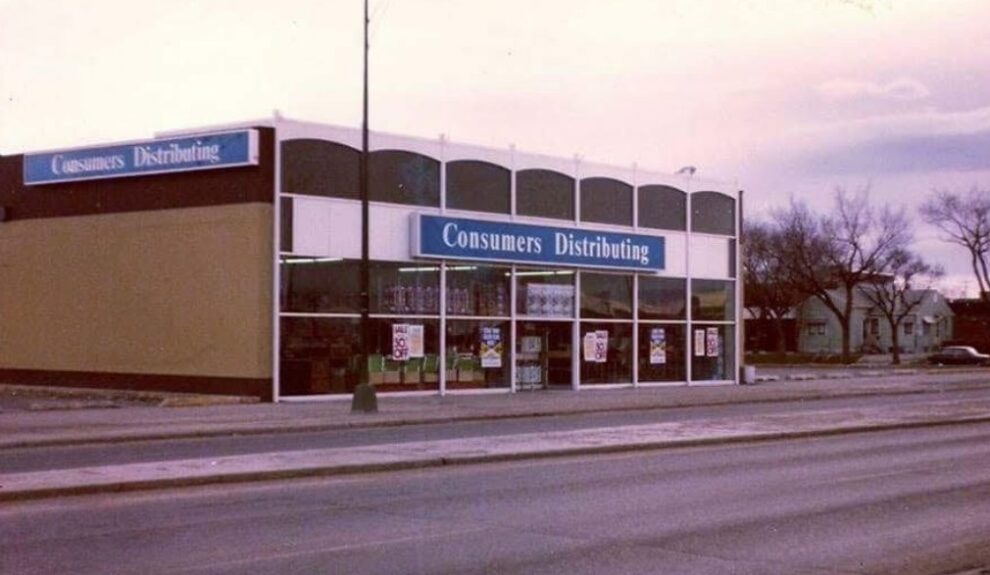

In the golden age of mid-century retail, Consumers Distributing was a household name and celebrated Canadian business. Launched in 1957, it expanded to 560 locations across North America. It was a force, buying up other chains and growing organically. By 1996, this darling was gone.
This is a familiar tale in Canadian commerce. Retailers like A&A Records, Bretton’s, Eaton’s, Agnew-Surpass and Simpsons once ruled their sectors—trusted names, embedded in the culture. Like many, Consumers Distributing was ultimately doomed by the same force that made it successful in the first place: its business model.
A model from the past, positioned for the future
In the early 1900s, grocery stores didn’t have aisles or carts—you handed over a list and staff fetched your items. Consumers essentially revived that system. No flashy showrooms or crowded shelves. Just a catalogue, a clipboard and a counter. It was cost-effective with savings passed on to consumers.
Customers browsed the latest offerings in the seasonal catalogue—a printed version of Amazon—and filled out an order slip. Behind the scenes, warehouse staff retrieved the items. Efficient, affordable and oddly futuristic. In a 2017 Toronto Star article, the model was dubbed “Internet shopping before the Internet.” That was a romantic notion but oversimplified and wrong.
The magic faded
Canadians loved it. Catalogue culture ran deep, thanks to the iconic Eaton’s catalogue, operating from 1884 to 1976. It was more than a shopping tool; it served as a window to the outside world and an escape for many Canadians, particularly in rural areas. People famously used the thick publications for home insulation, they were fashioned as hockey pads and they’ve been credited with teaching kids to read.
But the Consumers’ promise often fell short. Customers waited in line only to be told the item from the catalogue was out of stock. Instant gratification—something retailers now build entire strategies around—was missing.
Even kids, usually easier to please, were left disappointed at Toy City, Consumers’ toy store chain that made the baffling decision to remove the ability to touch and try the very products it sold. Toy stores without toys in your hands? That’s not magic—that’s frustration.
It didn’t help that the catalogue was printed every six months and the company had to honour prices even when costs inevitably rose. They eventually put out more frequent, shorter editions, but the damage was done.
Too little, too late
Customer complaints were in danger of outpacing purchases. To fix its flaws, Consumers launched several bold—but costly—initiatives:
- “Super stores” where in-stock items were visible
- Free home delivery and stock transfers between locations
- A real-time inventory system (ahead of its time) to suggest alternatives
All this did was paper over endemic problems. Perhaps the biggest problem stemmed from headquarters that failed to instill a service culture. It was a case of ‘they need us, more than we need them.’ Ultimately, Consumers Distributing failed at the most important job in retail: keeping the customer happy.
Operating costs ballooned. Consumer expectations changed. Retail competition—especially the arrival of Walmart—was fierce. Add in a recession, price deflation in electronics and mounting logistical challenges, and the hole was too deep.
Today, former Consumers locations are home to dental clinics, pizza joints and real estate offices. Thousands of people drive by them every day without a thought or nod to the brand.
In this era when nostalgia is both fond reminiscence and lifeline to a time when things made sense, Consumers is largely forgotten and not regaled to the same extent as other defunct retailers. Even its last decade, it was a dinosaur, made extinct by ever-more savvy customers who avoided its Soviet-like retail experience.
Jeff Swystun is owner of Swystun Communications, a Winnipeg branding, marketing and ghostwriting firm.


